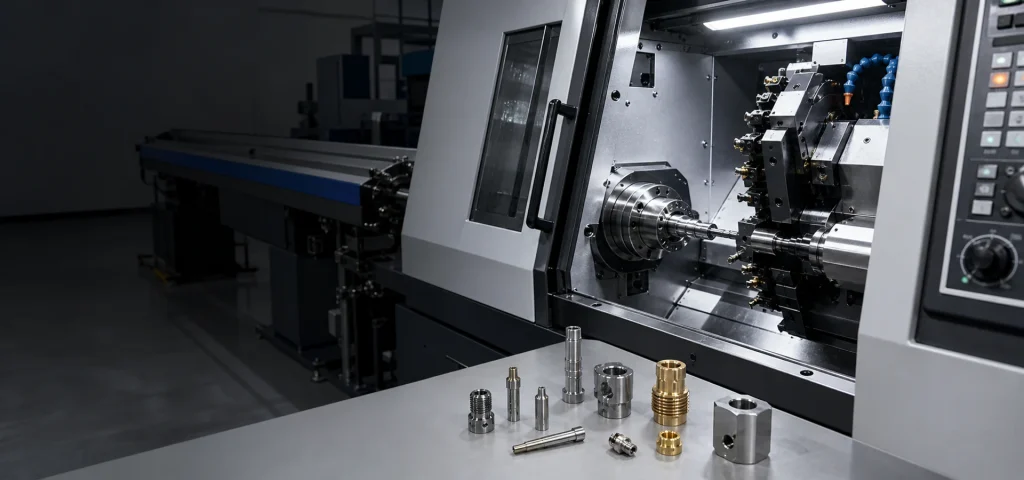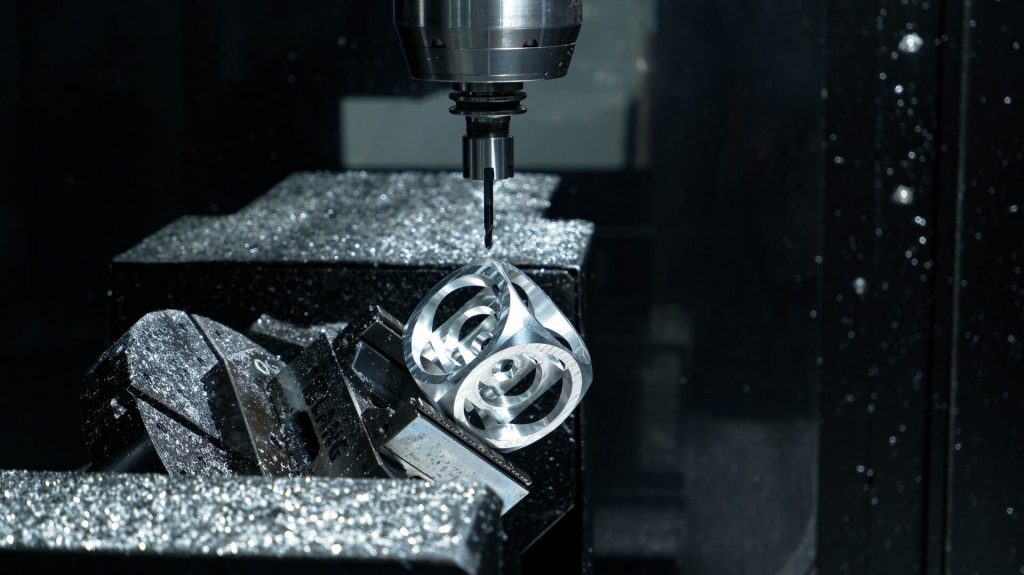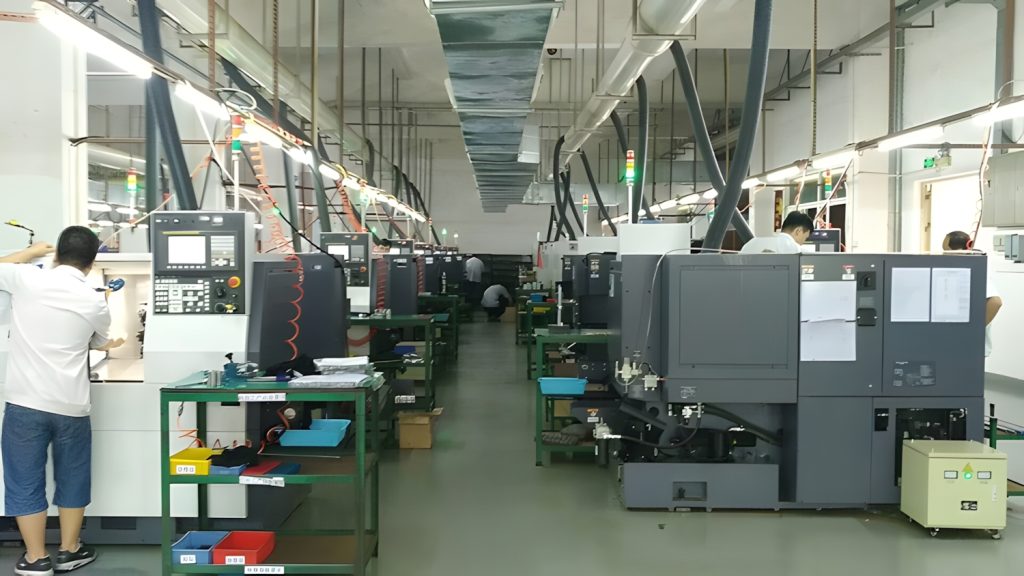

Mill-turn machining vs separate ops is a setup-count decision on a part that is already a turned family. Use mill-turn (live tooling on a turning center) when flats, cross-holes, slots, or wrench features must stay true to the turned journals in one clamp. Use separate ops when the milling volume is large, the mill needs a dedicated fixture, or the mill features are better on a 3-axis or 5-axis cell. ASME Y14.5-2018 datums should name that relationship. ISO 2768-1 (1989) still covers the loose sizes. Do not use this page to choose turning versus milling as the primary process family.
You already know the part is built around an axis. The remaining question is whether driven tools finish the off-axis features on the lathe, or a second machine takes them after turning.
This is the RFQ line that buyers send to a China factory after the lathe family is chosen. Send STEP, PDF, and a note on which features must not lose the first-op datum.
Key takeaways
- Mill-turn wins when a few mill features must hold to turned diameters without a second clamp.
- Separate ops win when mill time would clog a turning center or needs a mill fixture.
- Count setups, not axes, when you write the RFQ.
- A keyway on a shaft is usually mill-turn. A deep pocket on a turned blank is usually a mill op.
- If you cannot hold the mill feature in the lathe tool envelope, split the route.
Mill-turn machining vs separate ops at a glance
Mill-turn machining vs separate ops should be scored on clamp count, feature size, and which machine should own the long cycle.
| Factor | Mill-turn (live tooling) | Separate turning then milling | Best for | Watch-out |
|---|---|---|---|---|
| Setups | One turning-center clamp (plus sub-spindle if needed) | Lathe, then mill fixture | Flats and cross-holes on a shaft | Every reclamp can move runout |
| Mill feature size | Small: flats, holes, slots, hex | Large pockets, faces, 3D surfaces | Hardware on a journal vs a housing on a round blank | A big face mill does not belong on a lathe turret |
| Datum story | Mill features inherit the turned axis | You must re-establish datums on the mill | Position of a hole to a journal | Silent datums cause a second guess |
| Quantity | Strong when the combined cycle stays balanced | Strong when mill hours dominate | Repeat shafts with a keyway | An unbalanced mill-turn cycle blocks the lathe |
| Machine | Turning center with driven tools | Lathe plus a mill cell | Mixed but still round | Calling 5-axis does not fix a bad split |
| Slender bar | Live tools on chuck or Swiss | Mill vise on a thin pin is a fight | Cross-holes on Ø8 mm bar | Do not mill a high L/D pin in a vise if Swiss can drill it |
Bottom line: keep mill-turn when the mill work is a few features tied to the turned axis; split the ops when milling is a real second job.
If the part is still a lathe family, keep the drawing on CNC turning services and name mill-turn versus split in the notes.
Swiss can include live tools. That is still one setup on a sliding headstock, not “separate ops.” Separate ops means a second machine and a second clamp.
When live tooling should finish the part
Live tooling should finish the part when the mill features are small and functionally tied to the OD.
Examples: a wrench hex on a 304 fitting, a cross-hole through a 6061 manifold stem, a woodruff keyway on a 4140 shaft, or a milled flat that clocks a port to a thread. The turning center already holds the axis. Driven tools cut while that axis is still the datum.
ASME Y14.5-2018 is how you state that the hole’s position is to datum A on the journal (ASME Y14.5). If you leave the hole as a size-only callout, the shop may mill it in a later vise and lose the clock.
Tool envelope is the practical limit. A 6 mm end mill in a driven holder can cut a keyway. A 50 mm face mill cutting a 40 mm-wide pocket is not a turret job. Groove mills, small drills, and taps are the usual live-tool set. If you need a long reach into a deep cavity, you are already describing a mill.
Cycle balance matters on repeat lots. If turning is 90 seconds and live-tool work is 40 seconds, mill-turn is healthy. If turning is 60 seconds and live-tool pocketing is 8 minutes, you have parked a lathe behind mill work. Split that part so the mill cell owns the long cut.
Prototype quantity does not force a split. One cross-hole on a first article shaft is cheaper to cut with live tools than to build a mill fixture. Split when the mill work is actually a mill job, not because qty is 1.
Bar diameter still sits in the turning notes. Live tooling does not change stock form. Ø25 mm 4140 bar with a keyway is chuck mill-turn. Ø8 mm 303 bar with a cross-hole may be Swiss mill-turn (driven tools on a sliding headstock). Same feature type, different support.
A second example: M8 wrench hex on a 316L fitting, body Ø16 mm, overall 38 mm, thread on one end. Live-tool the hex on the chuck or collet lathe while the thread axis is still the datum. Do not saw the hex on a mill after parting off unless you have a pickup diameter and a clock feature. The hex is small mill work. It is not a mill job.
When you should split turning and milling
You should split turning and milling when the mill work would dominate spindle time or needs cutters and fixtures the turret cannot hold.
Examples: a turned 6061 hub that then gets a deep pocket network, a steel blank that needs a large face and a pattern of tapped holes, or compound surfaces that belong on 5-axis CNC machining. The lathe should leave mill stock and a datum diameter the mill can pick up.
ISO 2768-1 (1989) can still sit on the non-critical mill faces (ISO 2768-1). The pick-up diameter should have a real limit so the mill fixture is not guessing. Send mill features that need a real mill cell to CNC milling services.
NIST’s 2024 manufacturing metrology publications treat on-machine and post-process measurement as planned work (NIST). If you split ops, write which machine owns which balloons.
Leave a grip. A turned hub that is milled to a thin wall with no datum OD left is how mill fixtures slip. Keep a register diameter or a face the mill can indicate. Put that register on the drawing, not in a verbal “they will figure it out.”
Coating sequence matters after a split. If Type II anodize grows the mill faces and the turned journal, say which op happens before coating and whether sizes are before or after. Anodizing finishing services is the finish page. The route note still has to name turn-then-mill.
Do not split a slender pin into turn then mill-vise if the only mill feature is a Ø2 mm hole. The vise will bend the pin and you will lose runout you already paid to turn. Keep that hole on live tools, on chuck or Swiss.
A 6061 hub that needs both a turned Ø40 register and a 12 mm-deep pocket grid is the opposite case. Face-mill time and end-mill time will dwarf the turning cycle. Leave 0.5 mm mill stock on the pocket face if the mill owns the finish, or finish the register on the lathe and protect it in the mill fixture. Write which balloons the mill owns: pocket depth, hole position, thread class on the mill face. Write which balloons the lathe owns: register size, runout or circularity if it locates a bearing.
L/D and runout: why one clamp still loses (and why two clamps lose more)
L/D and runout explain why mill-turn machining vs separate ops is a clamp-count decision, not a branding decision.
High L/D on a chucked shaft already wants a tailstock or a rest during turning. Live-tool work on that same stick-out adds side load. A cross-hole drill on a 8:1 span can push the bar and open the hole position. If L/D is high and the mill feature is small, Swiss plus live tools keeps the cut next to the bushing. If L/D is high and you still split to a mill vise, you are asking a thin pin to locate from a turned OD that will deflect in the vise.
Runout is the scoreboard. Mill-turn keeps the turned axis. The keyway or hole inherits that axis if you put position or a clock to datum A. Separate ops can hold the same number only if the mill picks up a real datum diameter and the fixture does not crush the journal. A soft-jaw flip with no pickup is how 0.03 mm runout becomes 0.08 mm at first article.
Reclamping for back-end turning is a separate risk from mill reclamping. A sub-spindle on mill-turn can finish the back end and the cross-hole without a vise. Separate ops that turn one end, mill the hole, then turn the other end are three chances to lose the axis. Count those setups on the RFQ.
Bar diameter sets which mill-turn cell you even have. Large bar: chuck mill-turn. Small bar with a bushing: Swiss mill-turn. Separate mill ops do not care about bar diameter except as a fixture diameter. Write the bar or blank size so the shop does not open Swiss for a Ø50 mm hub.
L/D numbers belong in the same note as the route. “Mill-turn, L/D ≈ 7 on Ø10 × 70, tailstock allowed, live-tool Ø3 hole only after the rest is set” is a usable line. “Mill-turn, then mill the hole” on that pin is how the hole walks. If you cannot support the span during the driven-tool cut, either add a rest diameter, shorten the stem, or move the small bar to Swiss so the bushing sits at the cut.
If the print still says concentricity, translate it for the route. New ASME Y14.5-2018 drawings should use runout or position. The mill hole wants position to the journal. The spinning journal wants runout. Mixing those words across two ops is how inspection methods fork.
Mill-turn machining vs separate ops: decision tree and worked RFQ
Mill-turn machining vs separate ops closes with one route name on the RFQ: mill-turn in one clamp, or turn then mill in two ops.
- If the mill features are flats, cross-holes, slots, or a hex, and they must clock to a turned diameter, choose mill-turn.
- If the mill volume is a pocketed body, a large face, or a 3D surface, choose separate ops.
- If the mill cutter you would need is larger than the turret can run rigidly, choose separate ops.
- If first-article quantity is one and the mill work is a single cross-hole, still choose mill-turn.
- If the bar is small and slender (high L/D) and the mill feature is a driven-tool size, prefer Swiss live tools over a mill vise.
- If you cannot fit the mill feature in the lathe envelope, split. Do not hope the programmer will find a way on the turret.
Write “mill-turn, one setup” or “turn then mill, two ops” in the notes. Balloon the features that must hold across the split. Custom CNC machining services can carry mixed routes. Your line item still needs one route per part number.
Worked RFQ A, mill-turn. 4140 shaft, journals Ø20 h6, body Ø24, length 110 mm, 6 mm woodruff keyway, circular runout 0.03 mm journals to datum A, two M6 tapped cross-holes on a clock to the keyway. Stock Ø28 bar. L/D moderate; tailstock allowed. Route: mill-turn, one setup, live-tool keyway and holes. Not Swiss: bar and shoulder are chuck size. Qty 30. Cover note names indicator runout and keyway width.
Worked RFQ B, separate ops. 6061-T6 hub, turned register Ø40 g6 × 12 mm long, flange Ø90 × 18 mm, then a pocket network 14 mm deep with six M5-6H holes on a 62 mm pattern. Stock sawn blank. Route: turn register and flange faces, leave mill stock on the pocket side, mill pockets and holes on a mill picking up Ø40. Not mill-turn: pocket volume would clog the turret. Qty 25. Type II after both ops if the print requires coating, mask the register if it is a fit.
Worked RFQ C, Swiss live-tool, not a mill split. Ø7 mm × 58 mm 303 shaft, both-end M4 threads, Ø2.2 mm cross-hole, runout 0.02 mm. High L/D in a chuck. Route: Swiss with driven drill. Do not turn then mill-vise. Qty 150 after 10 first articles.
You are done when the route line, the bar diameter, the L/D support, and the runout or position balloons agree with each other. If the PO has all three part numbers, send three packs. Do not write “mill-turn or split, you decide” on a mixed list. The turret envelope and the mill fixture are different quotes.
For a prototype bridge on the hub only, still keep the split. Small batch CNC machining services does not merge a pocketed hub into a live-tool shaft cycle.
FAQ
Is mill-turn the same as a CNC mill?
No. Mill-turn is a turning center with driven tools. The workpiece still rotates for the OD and ID. A mill clamps the blank and spins the cutter as the main motion. Live tooling is for flats, holes, slots, and small hexes that must hold to the turned axis. Deep pockets, large faces, and 3D surfaces still belong on a mill. Calling mill-turn “just a mill” is how you park a lathe behind the wrong cutter.
Will separate ops always hurt runout?
They can, if the mill does not pick up a real datum. A well-planned mill fixture on a turned diameter can hold what the drawing asks. Put the register OD on the print with a limit. Put position of mill holes to that datum. If you mill a high L/D pin in a vise, expect the pin to bend and the runout you turned to move. Keep small holes on live tools when the bar is slender. Swiss plus live tools avoids the vise entirely on small bar.
Can live tooling replace a 5-axis mill?
No. Live tooling covers off-axis holes and flats on a round part. Compound surfaces still belong on a mill. 5-axis is an access tool for those surfaces, not a substitute for a turned journal. If the part is a shaft with a sculpted mill face, turn the journals, then mill the face on the mill cell. Do not force that face onto a turret B-axis and call it mill-turn success.
Should prototype parts always be separate ops?
No. One cross-hole on a prototype shaft is cheaper to cut with live tools than to fixture on a mill. Split when the mill work is actually a mill job. Qty 1 of a pocketed hub can still be turn-then-mill because the pocket is the job. Qty 1 of a keyway shaft should stay mill-turn. Prototype is not a process family. High L/D prototypes follow the same rule: if the only mill feature is a small hole, keep live tools (chuck or Swiss). Do not build a vise fixture that will bend the pin, then blame the China shop for runout you made impossible.
How do I tolerance a keyway that must align to a journal?
Put a position or a clocking control to the journal datum. Size the keyway width. Do not rely on a note that says “align with port.” If mill-turn owns the keyway, that control is cut in the same clamp as the journal. If you split ops, the mill must pick up the same datum or the clock will walk. Runout on the journal and position on the keyway are different controls. You usually need both.
What files do I send for a mill-turn quote?
The same turning pack: STEP, PDF, material, quantity, finish. Add a one-line route: mill-turn or turn-then-mill. Add bar diameter or blank size, whether a center hole is allowed, and which balloons are runout versus mill position. If the mill-turn cell is actually Swiss, say Swiss and the bar size. If the mill op needs 5-axis, say that on the split route, not as a substitute for turning.
When mill-turn machining vs separate ops is a named route, put that route on the drawing notes and send the STEP and PDF through contact us. Include L/D, bar diameter, and runout or position balloons so the shop can confirm turret access versus a mill fixture, or Swiss live tools versus a vise, before the quote locks.