
Know when 5-axis is not worth the cost: every feature is reachable on a 3-axis mill, the drawing uses ISO 2768-m (or looser) on general sizes, and you are not protecting a multi-face ASME Y14.5 datum frame. Typical skip cases: a 6061 plate with pockets on one side, a turned-and-milled shaft that only needs flats, a four-wall box with two vise ops, and a repeat lot that already has a fixture. Keep 5-axis when extra clamps would move true-position holes, when a one-off angled port has no jig, or when a short tilted tool is the only way to finish a deep pocket at Ra 3.2. Send STEP plus PDF and ask the Dongguan shop to quote 3-axis first unless you mark the faces that fail that plan.
This is a stop-doing-that guide for engineers who write “5-axis” on every RFQ to China. The machine can still cut the part. You are deciding whether rotary axes and extra CAM should be on the invoice.
If the geometry is simple, start with CNC milling assumptions. Upgrade only when a 3-axis sketch fails a datum or a tool-access check.
Key takeaways
- Skip 5-axis when 3-axis already sees every face and the datum stack survives two clamps.
- ISO 2768-m general sizes are not a reason to buy rotary interpolation.
- A dedicated 3-axis fixture often beats 5-axis once the design is frozen and quantity rises.
- “We have a 5-axis machine” is not a cost argument. Mode still has to earn the hour.
- Tell the shop to quote 3-axis first. Silence is how you buy CAM you did not need.
When 5-axis is not worth the cost: the short test
When 5-axis is not worth the cost, you can show it on a one-page test. Sketch the vises. If two orientations finish the part, and neither orientation breaks a true-position frame, stop. You do not need 5-axis for that RFQ.
| Situation | Skip 5-axis | Keep 5-axis | Best for | Watch-out |
|---|---|---|---|---|
| Access | All pockets, holes, and faces seen by one or two vises | A face or port no 3-axis clamp can present | Plates, simple boxes, covers | A hidden undercut you missed in the sketch |
| Datums | Sizes only, or datums on one or two faces | True position across three or more orientations | One-side brackets | PDF with no datums but a verbal “it has to fit” |
| Quantity | Repeat lot with a fixture already justified | Prototype, or a part that would need a new jig every revision | Frozen production | Revising the model after you paid for the fixture |
| Finish | Ra 3.2 or later anodize on prismatic walls | Blend that leaves a 3-axis witness line you cannot live with | Most industrial housings | Cosmetic preference dressed up as process need |
| Stickout | Finishing L/D ≤ 3 in the vise you already have | Floor only reachable at L/D ≥ 5 unless you tilt | Open pockets, lids | A tiny fillet forcing a 4 mm mill at 6×D |
Bottom line: if the vise sketch works, 5-axis is not worth the cost. Quote 3-axis and keep the 5-axis capacity for the next part that fails the sketch.
Write the sketch as a setup count, not as a feeling. “Vise 1 mills A and pockets. Vise 2 mills the back and through-holes. Done.” That is two setups. Unless a third face carries true position you will CMM, the RFQ is 3-axis.
Prismatic parts that 3-axis already reaches
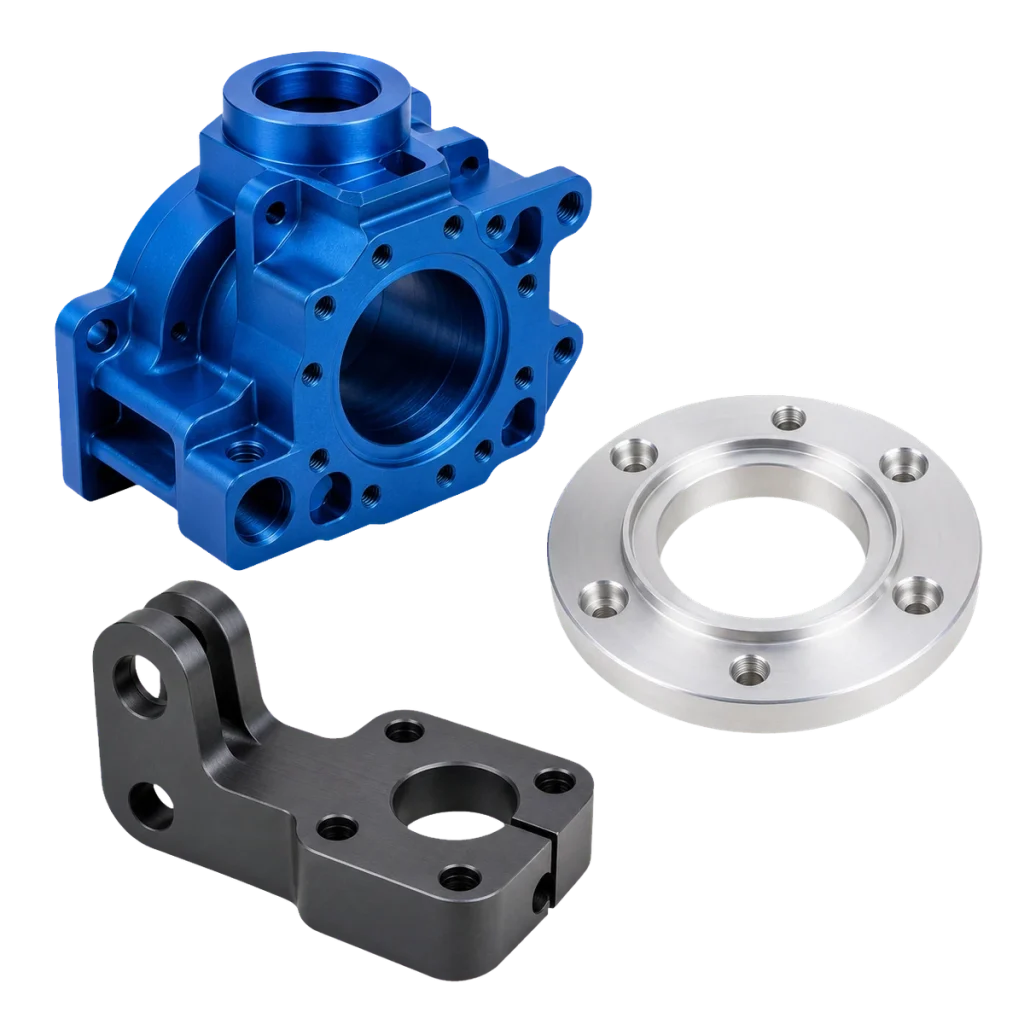
A prismatic part is planes, pockets, and holes along X, Y, and Z. That is most plates, lids, spacers, and many “housings” that are really four walls and a floor.
If the floor pockets, the rim, and the through-holes all face two setups, a 3-axis mill with a decent vise is the route. Adding rotary axes does not make 6061 cut straighter. It adds a tilt program and a longer collision check.
Turned parts with milled flats are another skip. Face, turn, mill two wrench flats, drill a cross-hole. That is mill-turn or 3-axis plus a collet block. It is not a 5-axis housing problem. If the shaft is the main body, start from CNC turning and add milling only for the flats. Rotary 5-axis on a mill is the wrong default for that family.
ISO 2768-1 (1989) medium covers the general sizes on these parts unless a fit is special. If you only needed 5-axis because you wrote ±0.02 mm on every outside wall, relax the walls first. That is cheaper than buying rotary time.
Typical skip geometries, with the setup count that should appear on the quote:
| Part type | Typical size class | 3-axis setups | Why 5-axis adds nothing |
|---|---|---|---|
| Lid / cover plate | 150 × 100 × 8 mm, pockets one side | 1, maybe 2 for the back | No compound face, no TP stack |
| Spacer / shim block | Prismatic, through-holes | 1–2 | Holes normal to the vise |
| Four-wall box, shallow well | 120 × 80 × 35 mm, well ≤ 15 mm | 2 | L/D stays low, datums on two faces |
| Bracket, holes on two faces | 80 mm envelope | 2 with a dowel relocate | Third face is cosmetic |
| Turned hub, two flats | Ø30 × 40 mm | Turn + one mill op | Not a 5-axis mill problem |
If your part matches a row, do not put “5-axis” on the email. Put “3-axis preferred” and attach STEP plus PDF.
A false 5-axis trigger on these parts is a pretty render with many pockets. Pocket count is not setup count. Ten pockets on one face are still vise 1 if the tool is short. Count orientations, then count L/D. If both stay in the skip table, the RFQ stays 3-axis. Another false trigger is a chamfer on every edge. Chamfers are 3-axis work. They do not need a trunnion unless they sit on a compound face you cannot present.
Turned hubs deserve a second look because buyers often mail them to a 5-axis mill by habit. Face, turn, groove, mill two flats, cross-drill. Setup count is a lathe plus one mill op, or a mill-turn. Indexing a mill through five poses to avoid a lathe is how 5-axis is not worth the cost on a round part. Split the packet: turning drawing and mill drawing, or one mill-turn note. Do not dress the hub up as a “5-axis housing” because a flat exists.
Loose general tolerances and cosmetic-only faces
Tolerance grade is a cost filter. If the drawing is ISO 2768-m, paint or anodize is cosmetic, and the only tight feature is a single bore you can hit in one 3-axis op, 5-axis is not doing quality work. It is decorating the quote.
Put ASME Y14.5 (2018) datums on the faces that assemble (ASME Y14.5). Leave the rest general. A shop in Dongguan will still inspect what you wrote. They will not invent a multi-face CMM program you did not ask for, and you should not pay for one.
Cosmetic witness lines from two 3-axis ops are real. If they sit under anodize on a hidden industrial box, accept them. If they sit on a consumer show face, that is a design or blending choice, not an automatic 5-axis buy. Sometimes a small fillet change removes the line.
Stickout is not a tolerance. A long tool can miss a ±0.05 mm wall even when the drawing is loose, because the wall tapers. That is still a 3-axis DFM problem first: larger cutter, open fillet, or a second roughing tool. Jumping to 5-axis because a 6 mm mill at 50 mm stickout chatters is backwards if you can present the floor with a 12 mm mill at 20 mm stickout in the same vise.
Dedicated fixtures vs rotary time
Quantity is where 5-axis stops being the default. A 12-piece prototype of a multi-face bracket can justify 5-axis because you will not build a tombstone. A 300-piece repeat of the same bracket, now frozen, often should not.
Do the fixture math without fake prices from this page: if a 3-axis fixture is a one-time tool and the cycle on 3-axis is shorter at a lower machine rate, production should leave 5-axis. If every lot still changes a port angle, stay on 5-axis and skip the tool.
This is the same logic used on small-batch CNC machining services. Low volume pays for flexibility. Repeat volume pays for a fixture.
A fixture is worth it when the pose list is stable. If you would have programmed P1–P6 the same way for ten lots, those poses can become six stations on a tombstone. If P4 (the 22° port) moves every revision, the tombstone is scrap and 5-axis is still cheaper. Write the revision habit on the RFQ: “expect port-angle changes for the next three lots” or “geometry frozen, 300 pcs/year.” The shop cannot guess that.
A fixture also loses when stickout is the real problem and the fixture does not shorten the tool. A tombstone that still mills a 40 mm well with an 8 mm end mill at 48 mm stickout is a 3-axis fixture with 5-axis pricing energy. If you skip 5-axis because quantity is high, the fixture still has to present the floor so L/D ≤ 3, or you must open the fillet. Skipping rotary time while keeping a long tool is not a skip. It is the same chatter with a lower machine rate and more scrap.
Worked skip RFQ: 6061 lid, 40 pieces
Part: 6061-T6 lid, 180 × 120 × 10 mm. Top pockets 6 mm deep, 12× Ø4.5 through-holes, four M3 holes on the back for a handle. ISO 2768-m. Ra 3.2. Type II anodize later, no mask except the back M3 threads. Qty 40, then likely 200 of the same revision.
Vise sketch:
- Vise 1: mill top, pockets with a 10 mm EM, drill Ø4.5. Stickout on the pocket: ~12 mm, L/D ≈ 1.2. Pass.
- Vise 2: mill the back, M3 holes. Through-holes already located from vise 1 if you dowel relocate. Datums A (top) and B (one long edge) live in two clamps. No third-face true position. Pass.
Setup count: 2. Angled ports: none. Stickout: not a problem. 5-axis is not worth the cost.
RFQ note: “3-axis preferred. No 3+2 unless a third vise would be required. No simultaneous paths. Quote fixture option at 200 pcs.”
What would flip this part: a 15° cable window on the long edge with true position to the top hole pattern. That is a third orientation and a datum stack. Then 3+2 on a prototype lot is worth discussing. The lid as drawn is not.
Contrast that with a part people wrongly skip. A 90 × 70 × 40 mm box with a 32 mm well, an 18° connector, and lid-screw TP to the connector is not this lid. Do not use the skip test as a way to ignore a failed sketch. The test is: sketch, count setups, check stickout, check datums. This lid passes. The box often fails.
Write the lid pose list even though it is a skip. It keeps the shop honest:
| Pose name | Meaning on this lid | 3-axis vise | Stickout |
|---|---|---|---|
| L1 | Top pockets and Ø4.5 | Vise 1 | L/D ≈ 1.2 on 10 mm EM |
| L2 | Back M3 | Vise 2 | Standard tap |
| L3 | (none) | Do not invent a trunnion pose | n/a |
If the quote comes back with six indexed poses and simultaneous blend time, the checklist failed on their side. Reply with L1–L2 and “when 5-axis is not worth the cost: this lid.” You are not arguing taste. You are arguing setup count.
When 5-axis is not worth the cost even on a 5-axis machine
When 5-axis is not worth the cost, the shop may still load the billet on a 5-axis mill and run it as 3-axis or as a simple index. That can be fine for scheduling. It is not fine if you are charged for simultaneous toolpaths you did not need.
Write the allowed mode. “3-axis preferred. 3+2 only if a third vise would be required. No simultaneous paths.” A process engineer can follow that. “Make it 5-axis” cannot.
NIST manufacturing pages treat process choice as a measured plan, not a machine inventory list, which is the right 2026 reading of an RFQ (NIST). If you cannot name the extra axis motion you are buying, you are not buying it on purpose.
Ask YXT 5-axis CNC machining services for a 3-axis-first review when the part looks prismatic. Write the allowed mode on the PDF: “3-axis preferred. 3+2 only if a third vise would be required. No simultaneous paths.” Circle exception faces, keep ISO 2768-m on general sizes, and list CMM only where the datum frame needs it. You are done when a programmer can plan vises without guessing you wanted a showpiece 5-axis program.
If the 3-axis sketch fails, you will get a reason: tool too long, third clamp on a true-position hole, or an undercut. That reason is when 5-axis becomes worth the cost. Until then, do not pre-buy it. Ask the shop to write the fail in those words. “Tool 8 mm at 46 mm stickout on the well floor” is a keep. “Part looks complex” is not. “Third vise would restack USB true position” is a keep. “We prefer 5-axis on all enclosures” is scheduling talk, not a process need.
A pose list can still help a skip decision. List the faces. If every face is 0° or 90° to the vise and L/D is low, the pose list is a vise list. You do not need a trunnion to execute it. Contact YXT CNC with STEP, PDF, and the 3-axis-first note so the reply can say “two vises” instead of “5-axis available.”
FAQ
When is 5-axis not worth the cost on a housing?
When the housing is a simple two-setup box with ISO 2768-m sizes and no multi-face true position. Angled ports or a deep pocket can still flip that call. Sketch the vises and write the stickout on the well. If vise 1 and vise 2 finish the box at L/D ≤ 3, skip 5-axis. If vise 3 appears because of an 18° gland that reports to A-B-C, stop skipping. The housing name does not decide. The setup count does.
If the shop already has 5-axis machines, should I still skip it?
Yes, as a paid strategy. The mill can run 3-axis. You are choosing the program, not the nameplate. Scheduling a prismatic lid on a 5-axis table as a 3-axis job can be fine if you are billed as 3-axis. It is not fine if the quote includes simultaneous CAM and a CMM frame you did not ask for. Put “3-axis preferred” on the PDF so the invoice matches the sketch.
Can I specify 3+2 but still skip simultaneous 5-axis?
Yes. That is the usual middle. Indexing is sometimes worth it. Live tilt often is not, on prismatic work. This article’s skip test is stricter: if two vises already work, skip indexing too. Use 3+2 when a third vise would appear, not as a default upgrade on every 5-axis-capable shop. Name both limits: no simultaneous paths, and 3+2 only if the 3-axis sketch needs a third clamp.
Does a tight bore mean I need 5-axis?
No. A tight bore needs a stable tool, a right sequence, and a matching gauge. It can be a 3-axis boring job. If the bore axis is normal to a vise face and the tool is short, 5-axis adds nothing. If the bore sits on a compound face that you will not fixture, indexing may help. The tightness is not the trigger. Access and stickout are. A H7 bore at 5×D on 3-axis is a DFM problem before it is a rotary problem.
Will a fixture always be cheaper than 5-axis?
No. Fixtures win on frozen, reachable parts at quantity. They lose on prototypes and on parts that still change every lot. Do not skip 5-axis on a 10-piece multi-face bracket because a tombstone “would be cheaper in theory.” You will not build it for ten pieces. Do skip 5-axis on a 300-piece lid that two vises already finish. Match the fixture decision to quantity and revision stability, not to a machine brochure.
What should I write on the RFQ to avoid a 5-axis default?
Write “3-axis preferred,” mark any exception faces, and attach STEP plus PDF. Add setup-count intent (“two vises”) and a stickout note if pockets are shallow. Do not use “full 5-axis” as a quality stamp. If you want a fixture option at a higher quantity, say the break. That packet is how a Dongguan shop knows when 5-axis is not worth the cost on your job.
Sketch the vises first so you know when 5-axis is not worth the cost. If they work, quote 3-axis and keep rotary CAM off the invoice. If a face fails that sketch, send the files for a limited 5-axis review via 5-axis CNC machining services or contact YXT with “3-axis first” on the PDF.