How to choose a CNC shop in China is a process-fit test, not a hunt for the lowest line. If the part is a 6061-T6 housing with pockets, you need milling. If it is a Ø20 mm 304 shaft with a cross hole, you need turning with live tooling. Send a STEP model and a PDF that shows datums, boxed tolerances, and Ra 3.2 (or Ra 1.6 on sealing faces). A shop worth the RFQ asks about L/D, names caliper vs CMM for the criticals, and states whether ISO 2768-m applies to open dimensions. Pay for one sample on the same revision you will buy, then check burrs, finish, and the report against the drawing.
You are a US or EU engineer or buyer with a real RFQ: material, quantity, finish, and a date. The China shop will quote from whatever you send, including missing notes. Shop choice is a drawing-control problem before it is a purchasing problem.
This is a filter for one RFQ cycle, not a plant-visit itinerary. Score process family, file control, DFM questions, inspection method, and one paid sample. Do not score brochure photos or WeChat speed.
Key takeaways
- Process fit (mill, turn, 5-axis) beats a glossy machine list.
- A usable quote names inspection method, stock, and ISO 2768 vs boxed tolerances.
- One paid sample on the production revision is the last filter.
- Traders can bundle processes. You still need the mill that will cut the metal.
- Award the shop that returns DFM questions you can put on the drawing.
Start with process fit, not a machine photo
A China CNC RFQ fails when you compare quotes from shops that cannot run the same setup. A 3-axis mill, a lathe with live tooling, and a 5-axis cell are not interchangeable cost models.
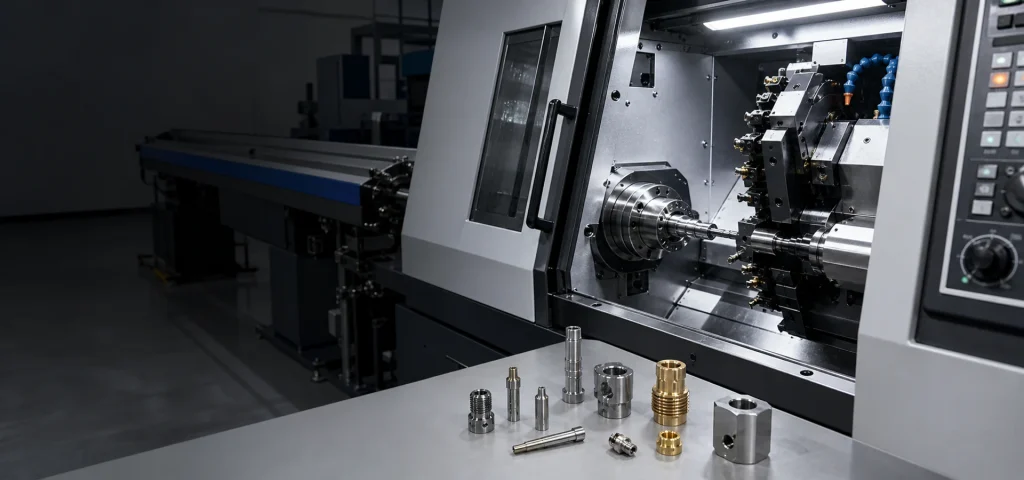
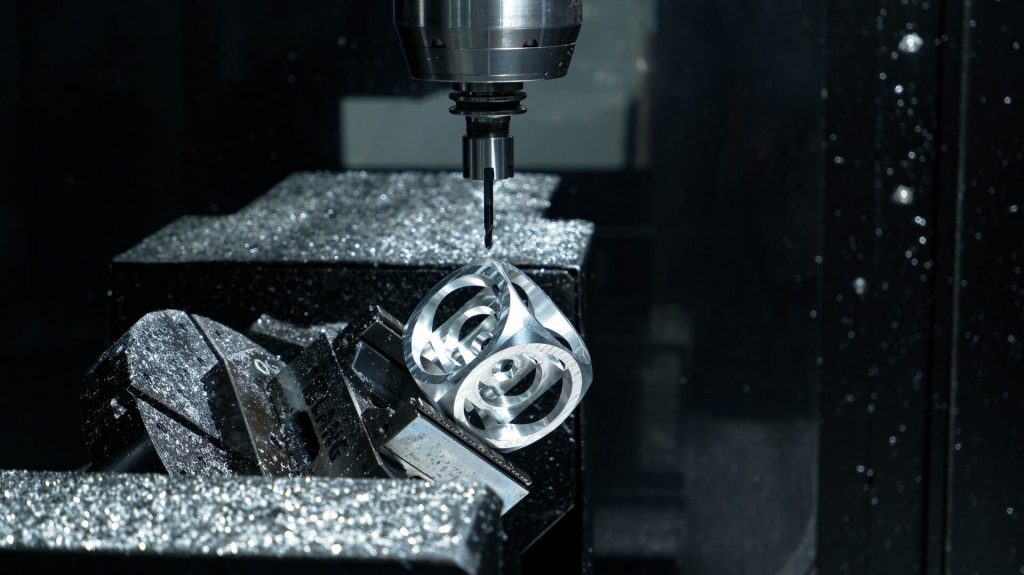
Map the part before you open the spreadsheet. Pocketed plates usually sit on CNC milling for housings and plates. Shafts and cross-drilled rounds usually sit on CNC turning with live tooling. Compound angles and multi-face datums may need 5-axis CNC machining. If the shop cannot say which machine family they would use, you do not have a comparable bid.
Say mixed routes in the RFQ so the quote is one conversation, not three unnamed subcontractors. A typical mixed route is a turned blank, milled faces, then Type II anodize. Write that sequence in the email body: “Turn OD and grooves, mill the flats and the pocket, then Type II black, dimensions after coat on the Ø12 H7 unless noted.” If you leave the route unsaid, Shop A prices mill-from-plate and Shop B prices turn-then-mill. Their numbers will not mean the same part.
Process fit also includes stock. A 6061-T6 cover that is 12 mm thick after machine is not the same job as a 6 mm plate with pockets that leave a 1.2 mm floor. Ask whether they start from plate, bar, or a sawn blank. The answer changes fixture, waste, and distortion. Write T6 on the RFQ. Temper changes how the mill treats thin walls.
If the shop answers “we have all CNC” and never names mill, lathe, or 5-axis for your file, treat that as a fail. You are asking for a route you can compare, not a machine serial number.
How to choose a CNC shop in China from the RFQ package
How to choose a CNC shop in China starts with a pack the shop can program from. Incomplete files force the estimator to guess stock, finish, and inspection.
Run this sequence on every new vendor.
- Export a STEP solid plus a PDF drawing (CAD export, ASME Y14.5-2018 datums). Done when the PDF revision matches the STEP filename and threads, Ra, and finish notes are on the 2D.
- State material and temper in the RFQ (6061-T6, 304/304L, POM-C). Done when the shop repeats the grade instead of writing “aluminum.”
- Ask which process family will cut the part (mill, turn, 5-axis). Done when they name the setup count or machine family.
- Require a written DFM note on three risk features (deep pockets, thin walls, tight position). Done when you get questions or a marked screenshot.
- Lock inspection on the criticals (caliper, micrometer, CMM). Done when the quote lists the method, and open dimensions point to ISO 2768-m or your block.
- Place a paid sample on that same revision. Done when packing list, burrs, and report match the revision you released.
A common failure is sending only a STEP. The shop will pick Ra 3.2 and ISO 2768-m, which fails if a sealing face needed Ra 1.6.
File-control details belong in the same pack. Name both files with part number and revision: COVER-A-REV-C.step and COVER-A-REV-C.pdf. Put the live revision in the email subject. If purchasing still has Rev B in a shared drive, say “supersede Rev B, quote Rev C only.” A shop that quotes the first attachment they opened quoted the pack they received. Make that pack unambiguous.
Write five commercial lines in the body so the estimator does not hunt Slack:
- Quantity: 5 now, break at 25 and 100
- Finish: Type II black, 8-12 µm typical film, mask 4x M4, sizes after coat on the two press bores
- Inspection: CMM on datums A-B-C and the two Ø8 H7 bores; caliper elsewhere
- Incoterms 2020 term: EXW Dongguan or FOB Shenzhen, labeled
- Material cert: mill cert to follow the bar or plate lot
If the package is ready, send it for a drawing-driven project review and judge the shop by the questions you get back.
Treat DFM questions as a pass/fail test
A shop that will not challenge L/D, inside corner radii, or anodize masking is silent about scrap. You want the estimator to name the end mill that can finish the pocket.
ISO 2768-1 (1989) still covers general tolerances when dimensions are open. ISO 2768-1 is a default, not a substitute for boxed fits. ASME Y14.5-2018 is the usual language for datums on US drawings; see ASME Y14.5.
Score the reply against this table. Do not average a fail with a low price.
| Filter | Pass | Fail | Best for | Watch-out |
|---|---|---|---|---|
| Process named | Mill, turn, or 5-axis stated | “CNC precision” only | First RFQ cut | Mixed parts need a written route |
| DFM questions | L/D, radii, finish asked | Silence plus a price | Complex 6061 housings | Cheap quotes hide assumptions |
| Inspection | CMM or gage named on criticals | “100% inspection” with no tool | Tight position / fits | Calipers cannot prove GD&T |
| Sample on revision | Packing list shows Rev C | “Similar part we made” | New vendor | Different finish is not production |
| File echo | “Quoting COVER-A Rev C” | Quote with no revision | Every RFQ | Old STEP still in their folder |
Bottom line: keep the vendor that can fill the Pass column in writing. Drop the vendor that fills the Fail column, even if the number is lower.
Incoterms change who owns freight risk. The Incoterms 2020 rules (ICC, 2020) are the vocabulary for EXW vs FOB vs DDP. Two quotes are not comparable if one is EXW Dongguan and the other is DDP your dock.
DFM that counts is specific. “Pocket A is 22 mm deep with R0.3 inside corners. A Ø6 mm end mill cannot finish that radius at this L/D. Open to R3 or accept a leftover fillet. Which do you want?” That sentence is a pass. “Looks fine, we can make” is a fail. You can paste the question onto the drawing and close the loop. A slogan you cannot paste.
If the shop asks whether ISO 2768-m applies to the bearing bore, they are reading. If they apply ISO 2768-m to a boxed H7 because you forgot to say “boxed wins,” they are guessing. Put the rule on the PDF: “ISO 2768-m unless boxed or GD&T.” Then see whether the quote repeats it.
Worked RFQ: score two shops on one housing pack
A worked RFQ makes how to choose a CNC shop in China concrete. You are not inventing a bake-off brand. You are running one pack through two reply styles.
Pack you send (keep this as a folder you can email twice):
HSG-440-REV-C.step(mm, 6061-T6 housing, overall 180 x 120 x 28 mm)HSG-440-REV-C.pdf(datums A-B-C, two Ø12 H7 bores position Ø0.05 mm to A-B-C, pocket 18 mm deep with R3, Ra 3.2 general, Ra 1.6 on the seal face, Type II black, mask 6x M5, ISO 2768-m unless boxed)- Email body: qty 8 + 40 + 120, EXW, mill cert required, CMM on the two H7s and the position frame
Shop A reply (pass shape): “Quoting HSG-440 Rev C. 3-axis mill, two setups, plate stock 30 mm. Pocket L/D is OK with Ø6 mm finish mill at R3. Type II after machine; we will mask M5 and measure H7 after coat as drawn. CMM on A-B-C and both H7s. Open sizes ISO 2768-m. EXW. Sample 2 pcs on Rev C before the 40.”
Shop B reply (fail shape): “Aluminum box, 7 days, 100% inspection, DDP.” No revision. No process family. No mask plan. No instrument.
Shop A named the file, the cutter family, the finish event, and the CMM. Shop B named a price wrapper. Awarding Shop B on the lower number is how you buy a part programmed from an old STEP, coated on unmarked threads, and “inspected” with a caliper on a position frame.
Use a scoring sheet you can fill in 10 minutes:
| Score item | Shop A | Shop B | What you record |
|---|---|---|---|
| Revision echo | Yes, Rev C | Missing | Quote belongs to which zip |
| Process family | 3-axis, 2 setups | Unstated | Comparable cycle time |
| DFM on pocket | R3 / Ø6 mill | None | Scrap risk after PO |
| Finish vs size | After coat on H7, mask M5 | Unstated | Assembly fail |
| Inspection tool | CMM named | “100%” | Report you can audit |
| Incoterms 2020 | EXW | DDP slogan | Landed cost |
| Sample plan | 2 pcs Rev C | None | Production filter |
Bottom line on this example: Shop A is the only bid you can put on a PO. Shop B is a conversation, not a quote.
Demand Shop A’s shape even from a mill you already like. Friendship does not freeze the revision. For a route-shaped bid, see custom CNC machining services.
How to choose a CNC shop in China after one paid sample
How to choose a CNC shop in China after the sample is a dimensional and handling check, not a feeling that the parts look good.
Measure the three features you marked as critical. Compare burrs to the drawing note. If Type II anodize was specified, check rack marks and plugged threads. If the shop skipped true position on the report, production will too.
Tie the box to the file pack. The packing list should show HSG-440 and Rev C. If it shows a shop job number only, you cannot prove which STEP was cut. Open the report and match balloon numbers to the PDF. A five-line “all dimensions OK” sheet is not a first article. You asked for CMM on two H7s and a position frame. Those lines must exist with measured values and a pass/fail against the boxed limit.
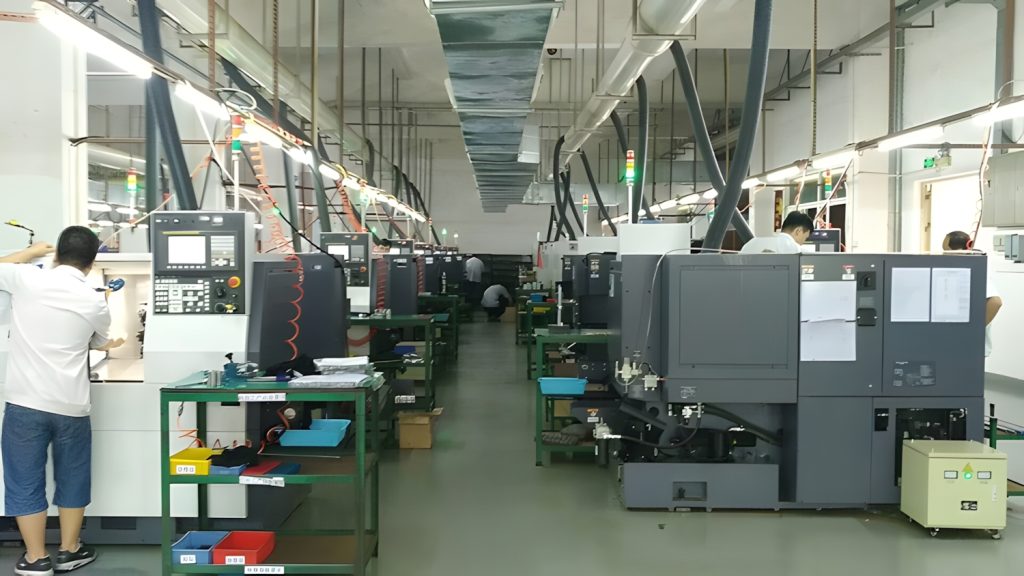
A video of the actual mill or lathe helps when you cannot fly. You want the vise or collet, not a lobby. About YXT CNC describes a Dongguan drawing-review workflow: files, DFM, process plan, cut, inspect, pack. Do not scale to production on a different revision than the sample.
File control after sample is where lots drift. If you change one hole to Ø12.2 mm, that is Rev D. Send a new STEP plus PDF pair. Kill Rev C in the subject line. Do not ask the shop to “just open the hole on the same program.” The sample you approved was Rev C. Production on an unmarked edit is a new part you did not vet.
Cosmetic class belongs in the sample plan. If the housing is a visible face, say light and whether mill marks after blast are allowed. A shop that ships heavy mill wash on datum A, then promises “production will be prettier,” has not shown production. Accept the sample as the cosmetic standard or reject it.
For aluminum CNC housings, check distortion after Type II. Thin floors chatter, then the seal face goes out of flat. If the sample is 0.08 mm out on a face you called Ra 1.6, do not order 120 until the shop states a fixture or stock change. You are choosing the mill that will own the next lot, not the mill that sent a lucky first piece.
A simple award rule for US and EU buyers
Award the shop that returned the DFM list, named the process, and matched the sample to the drawing. Do not award the shop that was fastest to a number and slowest to a question.
If two shops both pass, pick the one whose engineer can mark the PDF. Custom CNC machining services should be quoted as a route (machine family, finish, inspection), not as a catalog SKU.
Put the award in writing so file control survives purchasing. The PO should repeat part number, revision, material and temper, finish, inspection method, quantity, and the Incoterms 2020 term. Add “no subcontract of the critical mill setup without written approval.” If a trader is in the chain, the mill name still belongs on that PO. Fluency is not a substitute.
Lead time is a window after drawing freeze, not after the first WeChat. Write “sample after Rev C confirmation, production after sample approval.” A shop that promises “7 days” while anodize is still TBD started the clock on a different pack.
When volume grows, keep the same filters. Small-batch CNC machining still needs the revision echo and the inspection method. A 500-piece lot on a new mill is a new sample, even if the drawing did not change.
If the part later needs Swiss turning or a different cell, re-map process fit. Do not assume the housing mill is the shaft mill. The award rule stays: process named, DFM on the live revision, inspection named, sample on that revision.
FAQ
How to choose a CNC shop in China if I only have a STEP file?
Do not choose on STEP alone. Export a one-sheet PDF from the same model, even if open sizes are ISO 2768-m for now, then add threads, Ra, and finish before you compare prices. A STEP has no datum scheme, no thread class, and no Type II mask. Shops that quote from STEP only will assume Ra 3.2, no masking, and caliper inspection. You will then fight change orders when the seal face needed Ra 1.6. Send the pair named with one revision, and score shops on whether they echo that revision and ask about L/D or fits.
Do I need to visit the factory to choose a CNC shop in China?
No for a first prototype if you get DFM, a paid sample, and a real inspection report on your revision. Yes when annual volume, cosmetic class, or a regulated quality pack makes a bad lot expensive. A video of the vise or collet that would hold your size part is a useful middle step. A lobby tour is not. If you cannot travel, require the legal mill name on the quote, a revision echo, and balloons on the criticals. Skip the shop that will only send a catalog photo of a 5-axis machine you did not ask for.
Is the lowest China CNC quote a good filter?
No. The lowest quote usually omitted CMM, masking, mill certs, or used a different Incoterms 2020 term. Rebuild every bid with the same lines: material and temper, finish vs size, inspection tool, sample, and EXW vs FOB vs DDP. After that rebuild, the lowest remaining number can be a filter. Before that rebuild, the lowest number is a missing-scope flag. A shop that is slightly higher because they named CMM on two H7s is often the cheaper production buy.
Can a trading company be the CNC shop I choose?
Only if they name the mill, pass through DFM questions from the programmer, and ship samples from that mill on your revision. If they cannot name the cutter or the city, treat them as a mailbox. Confidentiality can be handled with an NDA and an access list. It does not require hiding the plant. Put the mill name on the PO and forbid silent mill switches. A trader who bundles sheet metal plus CNC can still be the commercial face. The shop you “chose” for machining is the mill that will hold the vise.
What inspection should I require on a first China CNC order?
Require the method that can prove the criticals: calipers for loose lengths, micrometers for diameters, CMM or a gage for position and profile. “100% inspected” with no tool is not a method. Write the three balloons on the RFQ and on the PO. If the sample report skips those balloons, fail the sample or freeze production until the method exists. Open dimensions can stay on ISO 2768-m. Do not pay for CMM on every edge unless you will reject on every edge.
How do I keep two China CNC quotes comparable?
Freeze one zip (STEP plus PDF, one revision), one quantity break list, one finish spec, one inspection list, and one Incoterms 2020 term. Send that pack to both shops on the same day. Reject any reply that quotes a different revision or a different freight wrapper. If Shop A is EXW and Shop B is DDP, convert before you rank. If Shop A includes Type II mask and Shop B does not, you are not comparing shops. You are comparing scopes.
If you need a factory to show how to choose a CNC shop in China in practice, send the STEP, PDF, material, quantity, and finish to YXT CNC project inquiry. Judge the reply by the DFM questions, the revision echo, and the inspection plan, then decide whether a paid sample is the next cut.