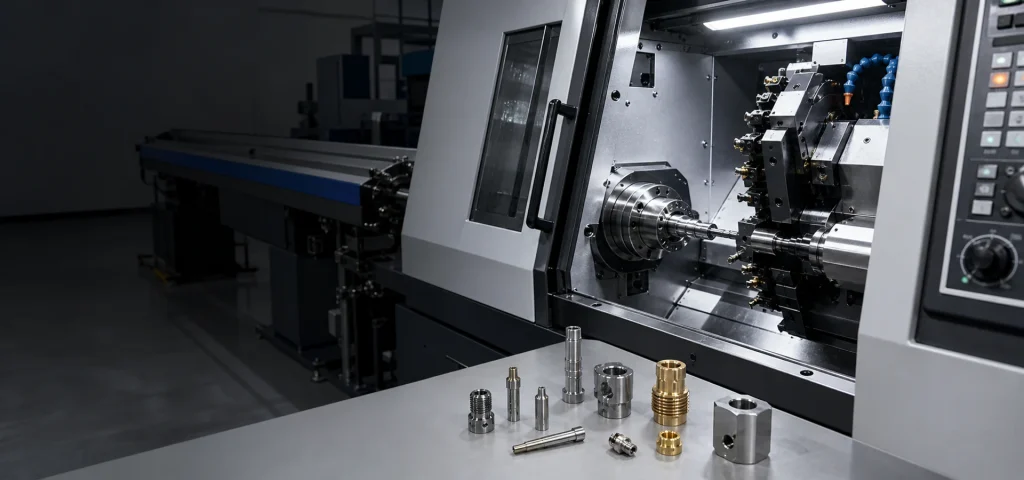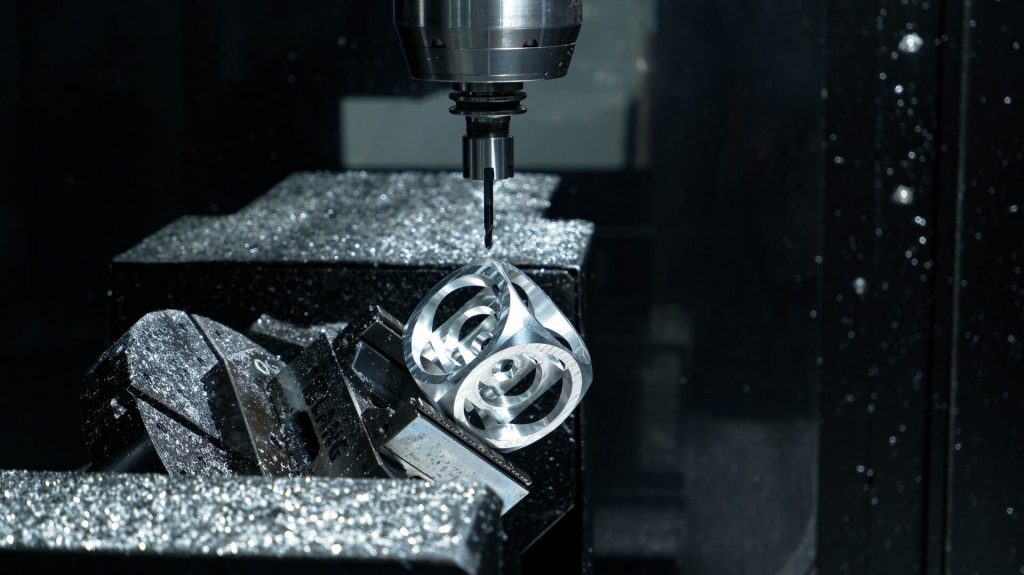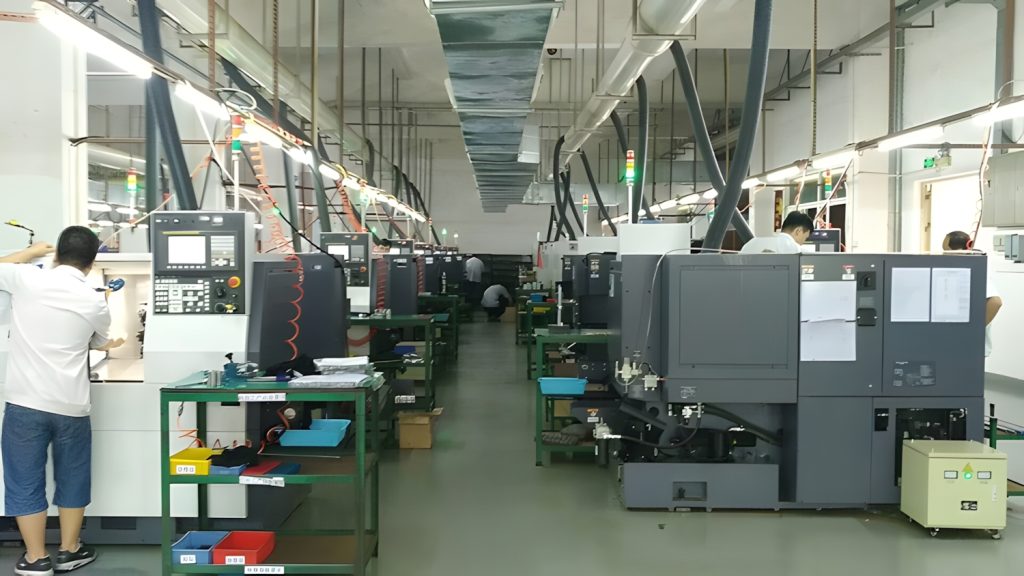
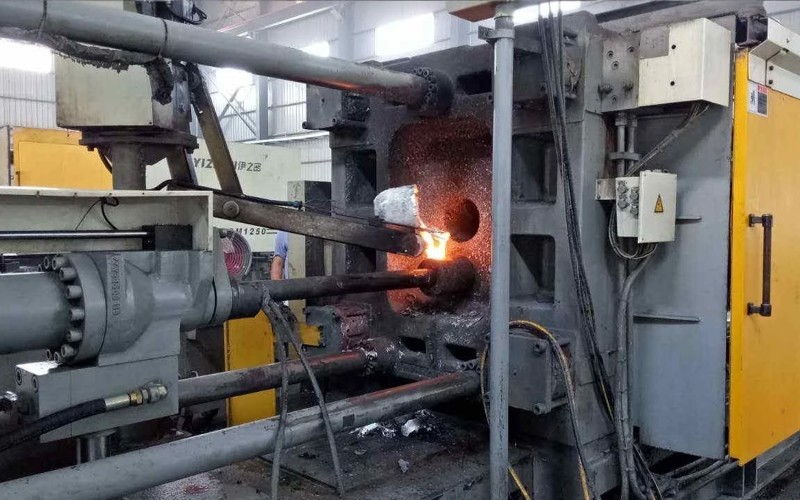
Aluminum CNC vs die casting is a volume, tooling, and property choice. CNC from 6061-T6 or 7075-T6 wrought stock needs no die, holds tighter fits, and matches mill-cert mechanicals (typical 6061-T6 tensile about 45 ksi / 310 MPa). Die casting (often A380 or similar) pays for a tool, wants draft, thicker uniform walls, and accepts some porosity. Use CNC for prototypes, revisions, and lots where the CAD still moves, commonly through tens or low hundreds of pieces, and for any feature that needs true position on a datum. Use a die when the housing is frozen, annual volume is high, and you can live with draft, ejector marks, and secondary machining on datums. Do not tool a part that will change next month. Do not CNC a 20,000-piece cosmetic box that a die can make.
US and EU teams often RFQ the same STEP as “machine this” and “cast this” in the same week. A Dongguan CNC factory can mill the first path. A die is a different supplier, lead time, and drawing language. Pick the path before you ask for two quotes that cannot share a fixture.
If the part is still a 6061 housing with moving PCB bosses, stay on aluminum CNC machining and small-batch CNC machining until the CAD stops moving.
Key takeaways
- No die, changing CAD, tight GD&T: CNC from wrought plate or bar.
- Frozen CAD, high annual volume, draft allowed: die cast, then machine datums if needed.
- Wrought 6061/7075 mechanicals are not the same as A380 die-cast properties. Do not swap them on a load-bearing arm.
- Anodize and cosmetics are easier to control on CNC 6061 than on many as-cast skins.
Aluminum CNC vs die casting at a glance
Aluminum CNC vs die casting should be decided from volume, revision risk, and which properties you need, not from which render looks cheaper. The table is the conclusion.
| Factor | CNC (6061 / 7075) | Die cast (A380 family) | Best for | Watch-out |
|---|---|---|---|---|
| Tooling | Fixtures only | Die and trim | CNC until CAD is frozen | A changed die is a new die |
| Volume | 1 to low hundreds natural | High annual volume | Repeat housings | Unit cost wins after the tool is paid |
| Mechanicals | Mill-cert wrought | Cast, possible porosity | Loaded brackets: CNC | A380 is not 7075-T6 |
| Draft / walls | No draft required | Draft, more uniform walls | Zero-draft boxes: CNC | Cast still needs process control |
| Tolerances | Feature GD&T | Wider as-cast; mill after | Press fits: CNC or secondary mill | Casting plus CNC is two processes |
| Finish | Type II / III on 6061 | Paint, powder, limited anodize | Color-critical 6061: CNC | Porosity prints under dye |
Bottom line: CNC until the drawing is stable and volume is high enough to retire a die; die cast only when you can accept draft, porosity risk, and a frozen CAD.
Tooling, volume, and when the die actually pays
A CNC fixture for a 6061 housing can be a vise or a nest. That cost can change when the CAD changes. A die is a product. If you still owe yourself three PCB spins, you are buying a die for a part that will not exist.
A practical split: pieces 1-50, CNC only. Pieces 50-300, CNC unless the geometry is already a cast-friendly box and the CAD is locked. Above that, compare tool life, secondary machining, and scrap. There is no universal break-even count. Do not open a tool on a housing whose lid screw pattern still moves.
Fixture time on CNC is measured in days. Die design, steel, and tryout are measured in weeks to months. If the PCB layout is not frozen, those weeks buy a tool for the wrong boss pattern. Bridge with CNC 6061, Type II 8-20 µm if you need the black box now, then recut draft and wall uniformity before anyone cuts die steel.
CNC can start when stock lands. A die needs design, steel, tryout, and sample approval. If you need parts this month, bridge with custom CNC machining services, then recut the drawing for draft before you tool.
Quantity alone is not a die. A 2,000-piece 7075 arm can stay CNC because the mill cert is the product. A 400-piece motor cover with generous draft can still be worth a simple die. Write the reason on the RFQ.
Alloys, porosity, and what the mill cert means
In 2024 alloy tables from the Aluminum Association, typical 6061-T6 tensile strength is about 45 ksi (310 MPa). 7075-T6 typical tensile is much higher, often cited near 83 ksi (572 MPa). Die-cast A380-family alloys are chosen for fill, not for those wrought numbers. If the part is a structural arm, CNC 7075 or 6061. If it is a motor cover that mostly has to look even, a die can be enough.
Porosity is the cast tax. Thick bosses shrink. Leak-tight cavities and Class A dye are the usual failures. You cannot inspect porosity away with one CMM hit. If the box must be leak-tight, CNC from plate or specify impregnation and a test on the cast path. Do not assume as-cast walls are pressure-tight. A 2 mm cast rib with a shrink pore under Type II dye will print as a dark speckle. That is why powder or paint is the usual cast cosmetic, and why 6061 plate stays the Type II path.
CNC plate can still banana from residual stress. Call flatness where the gasket lives. ISO 2768-1 (1989) medium general tolerances are a starting band for non-critical CNC sizes, not a porosity spec. ASME Y14.5-2018 (reaffirmed 2024) is how you put true position on a CNC datum. As-cast datums need a secondary mill if that true position is real.
Do not write “6061 equivalent” on an A380 drawing. It is not. If a later revision needs 7075 strength, you are back on CNC or a different casting alloy with a new tool conversation. 2024 manufacturing metrology notes from NIST are a reminder to name a leak or CMM method if those results are contractual on either path.
Tolerances, walls, and secondary machining
As-cast housings often need milled datums, gasket grooves, and bearing bores. That is aluminum CNC vs die casting as a hybrid, not a pure choice. Budget the secondary mill when the die cannot hold a press fit or a seal. Do not assume the as-cast hole is an H7.
CNC from solid can hold feature tolerances that a die will not. Put GD&T on the faces that assemble. Name CMM, gauges, or air decay if leak is the requirement. A tolerance without a method is a wish on either path.
Walls: CNC can locally go to 1.0 mm with fixturing, and 0.8 mm as a supported local feature. 0.5-0.7 mm is special even on CNC. Dies like more uniform, draft-friendly walls, often thicker than a pocketed CNC lid. If the skin is 0.8 mm with zero draft, you are still on CNC, or you redesign for cast. Do not force a die to make mill geometry.
Internal radii follow the process. CNC wants 1.5-3 mm to match an end mill. Cast wants generous fillets for fill and ejection, often larger than a mill radius. Recut the model before you tool. A CNC-friendly sharp pocket is a cold-shut risk in a die.
Type II on CNC 6061 is the lower-risk black-dye path until you have proven a cast finish. Type III hardcoat is a wrought-aluminum conversation (12.7-114 µm, 50.8 µm if blank). Many as-cast skins take paint or powder more predictably than Type II Class 2.
| Wall / feature | CNC from plate | Die cast | Best for | Watch-out |
|---|---|---|---|---|
| 1.5-2.0 mm, no draft | Routine | Redesign with draft | CNC housings | Casting without recut |
| 1.0 mm local | Common with support | Unusual as-cast | Weight-sensitive CNC | Porosity in thin cast ribs |
| 0.8 mm window | Thin-wall CNC | Redesign | CNC only | Die fill and warp |
| H7 / press fit | Mill to size, mask anodize | Secondary mill | Either path with mill | As-cast hole as H7 |
| Ground pad 6-10 mm | Mask Type II/III | Often as-cast or mill | CNC anodized boxes | Dye on a cast pore |
Bottom line: if the skin is a zero-draft 1.0 mm art piece, stay on CNC until you recut for cast.
Anodize, mask pads, and cosmetics on each path
CNC 6061 takes MIL-A-8625 Type II at 1.8-25.4 µm (practical 8-20 µm sealed Class 2) and Type III at 12.7-114 µm (often 25-50 µm). That is why a milled housing can be a uniform black with hatched 6-10 mm earth pads. Cast aluminum can be anodized in some shops, but porosity prints through dye, and color lots are harder to hold. If the catalog photo is Type II black on 6061, do not assume the die-cast successor matches.
Masking on CNC is a drawing view: hatch pads, plug M3-M5, keep rack marks off the A-side. On a casting, secondary-milled pads can be the earth path after paint. Write that sequence. Do not mix “anodize all over” from the CNC drawing onto a cast part that will be powder coated.
Thin CNC walls and Type III do not mix casually. A die-cast wall is usually thicker, which can survive a coating cycle better, but it is still not 6061-T6 Type II. Pick cosmetics on the process you will actually ship.
If EMI lands must stay conductive, CNC mask anodize is the controlled path. Cast-plus-paint needs a masked or milled land and a continuity check either way.
Hybrid jobs fail when the drawing still talks like a mill. Typical failure: a CNC 6061 PDF with Type II Class 2, 8-20 µm, masked H7, and 1.0 mm zero-draft walls is sent to a caster with “same as CNC.” The die cannot make that wall, the dye will not match the 6061 coupon, and the H7 is still a mill op. Recut walls to 1.6-2.0 mm with draft, move cosmetics to powder, keep secondary mill on gasket and bores, and hatch or mill 6-10 mm earth pads after paint. Price the mill ops. They are not free because a die exists.
Keep a CNC bridge while the die is in tryout if sales need boxes. The bridge lot should use the CNC drawing, not a half-drafted cast model. When the die is approved, obsolete the CNC revision so purchasing does not mix 6061 Type II lids with A380 powder lids in one shipment.
Decision tree for aluminum CNC vs die casting
Walk this in order.
- If the CAD will change in the next two builds, choose CNC. Do not cut a die.
- If the part is structural and needs 6061-T6 or 7075-T6 mill properties, choose CNC. Do not substitute A380.
- If you need leak tightness, Type II cosmetics, or fits under a few hundredths of a millimeter without a secondary mill, choose CNC.
- If walls are 0.8-1.0 mm with zero draft, choose CNC or recut. Do not force a die.
- If the housing is frozen, draft is acceptable, annual volume is high, and porosity is allowed or inspectable, choose die cast. Add CNC only on datums and functional bores.
- If volume is high but the skin is still a zero-draft 0.8 mm art piece, redesign for cast or stay on CNC.
Worked RFQ example, CNC path: 6061-T6 handheld box, 120 × 80 × 30 mm, 1.2 mm walls, Type II Class 2 black 8-20 µm, mask two H7 dowels and an 8 mm earth pad, quantity 80, CAD still moving. Stay CNC. Do not open a die.
Worked RFQ example, cast path: same envelope after spin 4, 1.8 mm walls with 1.5° draft, annual 8,000, powder coat, secondary mill gasket and four bosses, porosity allowed if leak test waived. Now a die can win. Recut the STEP for draft before tooling. Keep a CNC bridge lot if sales cannot wait for tryout.
Worked RFQ example, stay CNC at volume: 7075-T6 arm, 220 mm long, 4 mm webs, Type III Class 1 25-50 µm on the slide, mill-cert tensile required, 1,500 pieces per year. Stay CNC. A die in A380 would change the load case. Mask the pivot bore or mill it after coating. Do not recut this part for cast to chase unit cost.
CNC RFQ fields: STEP + PDF, alloy/temper, quantity, finish (Type II 1.8-25.4 µm or Type III 12.7-114 µm), min wall, mask pad sizes, critical fits, inspection. Cast RFQ fields: add draft direction, parting line, annual volume, secondary mill list, leak test yes/no, and which cosmetic process replaces Type II. Do not send one drawing labeled “CNC or cast, you choose.” When the CNC pack is ready, use YXT CNC contact. CNC milling of datums on a casting is a second job. Price it as one.
Secondary mill on a casting should be a named list, not “machine as needed.” Typical list: datum A face, gasket groove, bearing bores to after-coat size, connector cutout, 6-10 mm earth pads if the cosmetic coat is insulating. If the cast wall is 2 mm with draft, you can mill a local 1.5 mm pocket. You still cannot mill the whole skin to a 0.8 mm CNC window without changing the process back toward plate. Write stock allowance on each milled face so the die designer leaves metal.
FAQ
Is aluminum CNC vs die casting only about piece price?
No. Tooling risk, revision speed, mechanicals, and cosmetics usually dominate the first year. A cheap cast piece with a die you will recut twice is not cheap. A CNC 6061 box at 80 pieces can be the entire first-year demand. Compare tool cost, secondary mill, scrap, and the chance the PCB bosses move. Piece price without those lines is a spreadsheet, not a process choice.
Can I die-cast a part designed as a CNC 6061 block?
Not as-is. Add draft, uniform walls, fillets, and ejector locations. Then decide which faces still need milling. Zero-draft 1.0 mm CNC walls become thicker drafted skins. Sharp mill pockets become fill radii. H7 holes become secondary mill. Type II Class 2 on 6061 becomes paint or a proven cast anodize, which is a coupon. Recut the model, then RFQ the die.
Will a die-cast housing match 6061-T6 strength?
No, not in the typical published wrought sense. If you need 6061-T6 numbers, machine 6061-T6. A380-family fill alloys are not 45 ksi mill-cert 6061-T6, and they are not 83 ksi 7075-T6. If the part is a loaded arm, stay on CNC. If the part is a cover, cast strength can be enough. Write the alloy you will ship, not “aluminum.”
How many pieces before a die wins?
There is no single number. If the CAD is unstable, the die never wins. A frozen 400-piece cover with draft can beat CNC. A 5,000-piece 7075 bracket can stay CNC. Run the tree: revision risk, mill cert, leak and dye, then volume. Do not open a tool to hit a round number in a slide. Count secondary mill and scrap before you call the die cheaper.
Should prototypes be CNC even if production is cast?
Yes. Prototype in CNC, then recut the model for castability before tooling. Use the CNC lot to freeze bosses, gasket, and connectors. Then add draft and wall uniformity. Keep Type II cosmetics on the CNC prototype so electrical and mechanical teams can test. Do not anodize a cast tryout and compare it to a 6061 coupon as if they were one finish.
Can I anodize a die-cast housing like CNC 6061?
Sometimes, but it is not the same process window. CNC 6061 Type II 8-20 µm sealed Class 2 is the controlled black path. Cast skins can print porosity under dye. If the product requires that black, stay on CNC 6061 or prove a cast coupon. Mask pads of 6-10 mm still apply if any anodic film is used. Paint-plus-mill pads are the more common cast earth path. Do not copy a CNC Type III 50.8 µm note onto A380 and expect a 6061 coupon to match.
Decide aluminum CNC vs die casting with the tree above: CNC while the CAD and the mill cert still matter; die only when volume, draft, and a frozen housing line up. Send a CNC-ready STEP + PDF to YXT CNC if you are still in prototype or low volume. Do not buy a die to save a revision you have not made yet.